MEDRXIV PREPRINT / METABOLOMICS

NMR metabolomics for cardiovascular–kidney–metabolic risk stratification in an integrated healthcare system

Can a single blood metabolic profile improve risk prediction across the cardiovascular–kidney–metabolic continuum beyond the standard-of-care?

01 THE BIG PICTURE

Beyond conventional
risk prediction.

We measured 250 blood-based nuclear magnetic resonance (NMR) biomarkers in 54,933 Kaiser Permanente Research Bank participants and linked these profiles to longitudinal electronic health records.

Across nine cardiovascular–kidney–metabolic (CKM) disease endpoints, adding metabolomic information to standard clinical predictors improved risk discrimination—most notably for chronic kidney disease, type 2 diabetes, and metabolic dysfunction-associated steatotic liver disease.

02 KEY FINDINGS

Key results
at a glance.

NMR improved prediction most for early CKM endpoints—chronic kidney disease, type 2 diabetes, and MASLD.

02 / BEYOND ONSET

Risk prediction after diagnosis

NMR provided additional prognostic information for disease-related and cross-organ complications, including kidney and cardiovascular outcomes in participants with established disease.

Primary + secondary prevention
03 / ROBUSTNESS

More informative across patient groups

Added predictive value generally persisted across demographic, anthropometric, and genetic-risk strata, with the largest gains often seen where conventional prediction was weakest.

Subgroup evaluation
03 PROVIDING CLINICAL UTILITY

From prediction to prioritization.

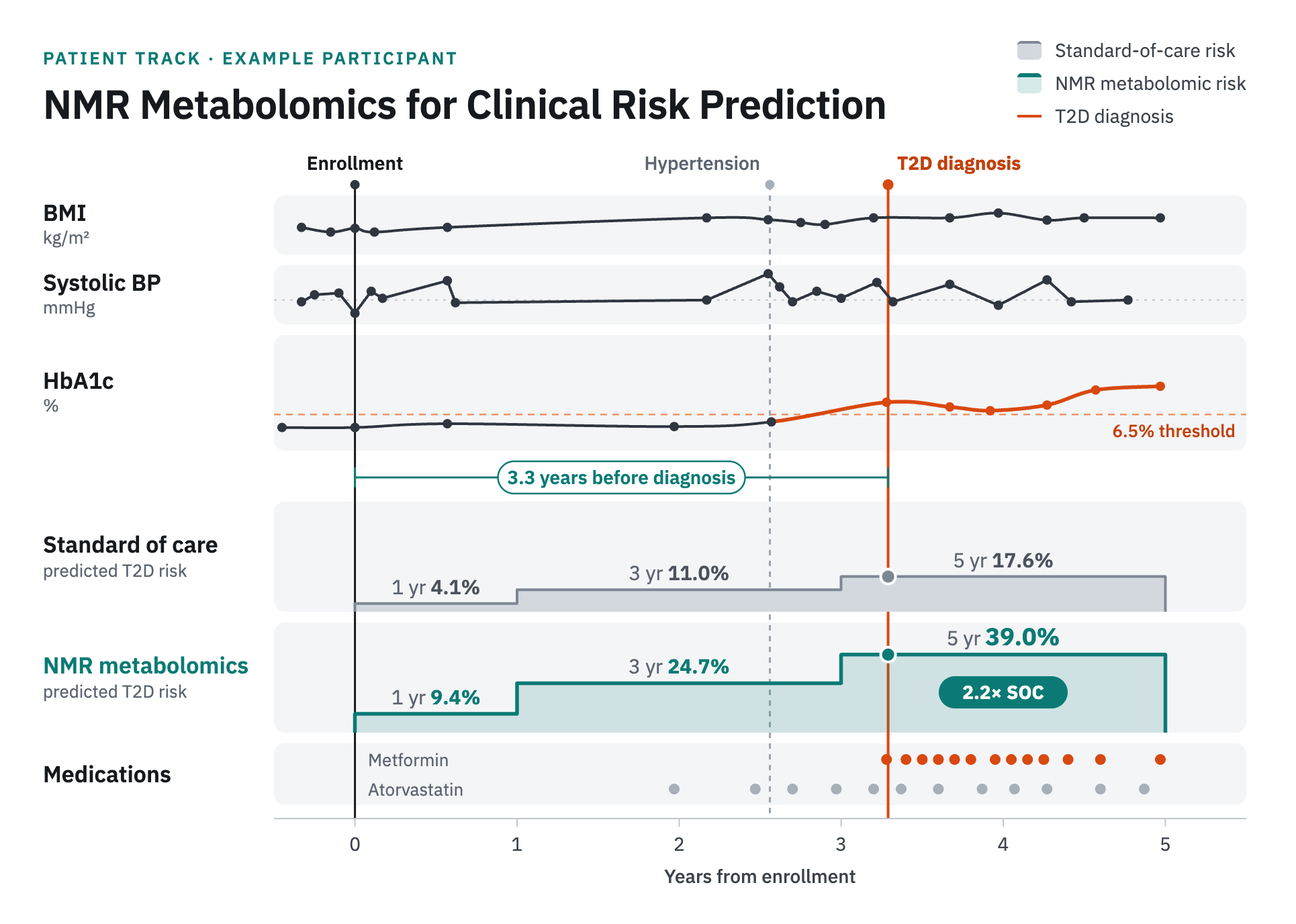
NMR-enhanced models generally maintained calibration and improved decision-curve net benefit—thus supporting the incorporation of NMR-enhanced risk prediction in patient-level reports:

Example participant track comparing standard-of-care and NMR metabolomics predicted type 2 diabetes risk over years from enrollment, with higher NMR risk preceding clinical diagnosis.
Patient track · example participant — NMR metabolomics vs standard-of-care risk before type 2 diabetes diagnosis.
View the research on medRxiv
04 RESEARCH TEAM

Science is
collaborative.

A collaboration spanning Weill Cornell Medicine and Kaiser Permanente.

Authors

Jonathan Chacon-Barahona1, Carlos Iribarren2, Jamal Rana2, Gina Rinetti Vargas3, Sarah Rowell3, Olivier Elemento1, Karsten Suhre1,4, Devin Absher3, Jan Krumsiek1

Affiliations

  1. 1 Department of Systems and Computational Biomedicine, Weill Cornell Medicine, New York, NY, USA
  2. 2 Division of Research, Kaiser Permanente Northern California, Pleasanton, CA, USA
  3. 3 Kaiser Foundation Health Plan, Kaiser Permanente, Oakland, CA, USA
  4. 4 Bioinformatics Core, Weill Cornell Medicine–Qatar, Doha, Qatar
LET'S CONNECT

Questions, ideas,
or collaborations?

I'd be glad to discuss the research, methodology, or opportunities to collaborate.

jac4021@med.cornell.edu